Tutorial Tuesday (Photoshop Elements)

True Colours – Not Just a Song

Has anybody seen my mojo? It seems to have gone walkabout without me! I haven’t scrapped a single thing this month. Not one. That can’t be allowed to continue!!

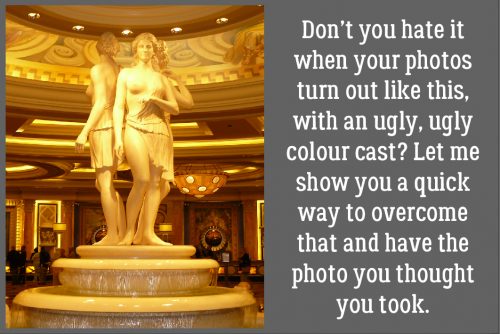
Today I thought I’d show you a really quick (literally only 5 minutes of your precious time) photo edit that will help you save those special photos that just aren’t. I think we’ve all taken a bunch of photos of a special event or trip, only to find out when we’re ready to use them that they’re not quite the masterpieces we thought they would be. Sometimes that’s because the lighting did weird things to the colours… like in my example photo below. For those who’ve never seen it, this is the Three Graces fountain at Caesar’s Place in Las Vegas. But it’s not supposed to be yellow.

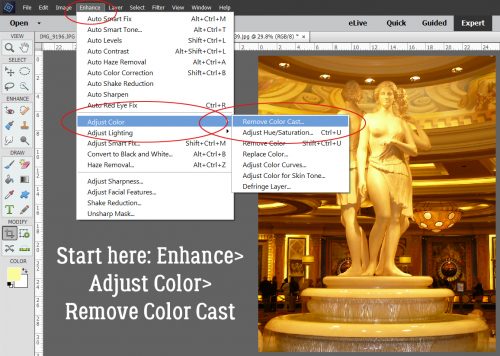
The path to solving this problem and unlocking the true colours in your photo goes like this: Enhance>Adjust Color>Remove Color Cast.

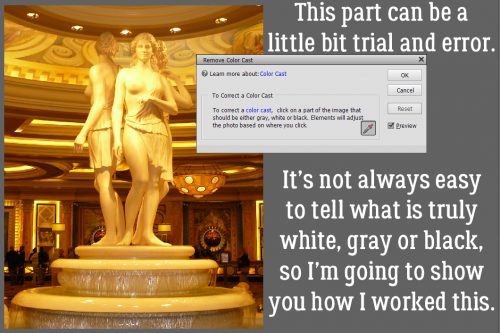
Fixing an ugly colour cast is pretty simple, but it often is a bit of a trial-and-error exercise. Everything in the photo is affected by the same odd colouration so you’ll be making some guesses. The tool works by using an algorithm to adjust the colours based on you telling it which areas of the photo are either white, gray or black. The trick is to figure out which is what!

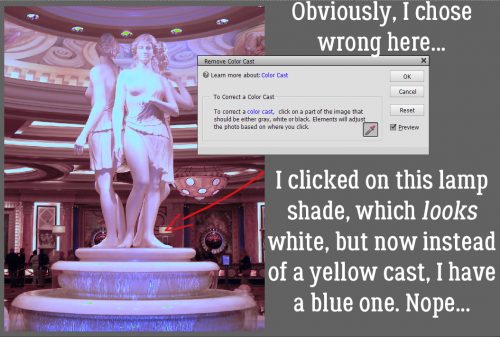
Because my photo is 10 years old, I really can’t remember the kind of details that would make this easy. So I just picked a spot – the lampshade – that I expected to be white. But I was wrong.

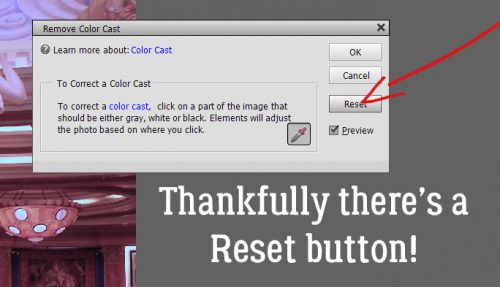
Fortunately, with a single click, I can Reset the image and try again.

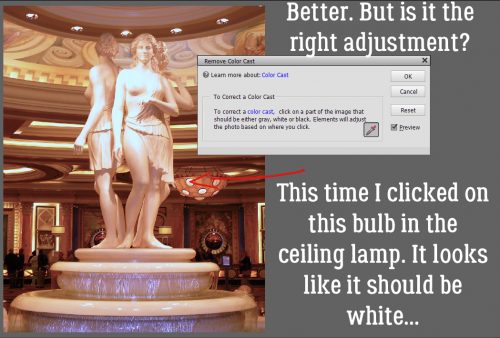
This time I chose the bright light in the chandelier as my “white” source. The result is better, but is it right?

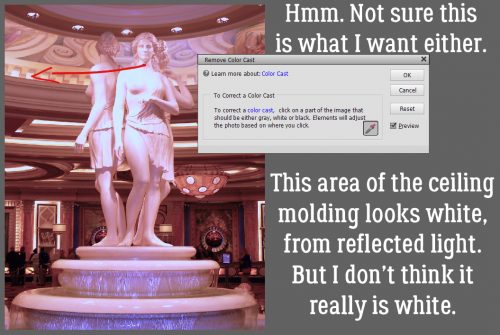
So I went to the reflected light in this molding. It looks white… but apparently it isn’t.

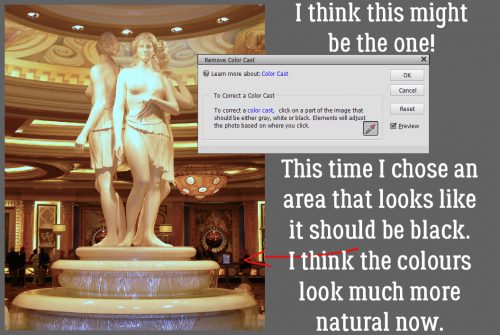
I was obviously failing with the white areas, so then I tried a spot that looked like it should be black… the sleeve on the jacket this woman is wearing. Better. Best?

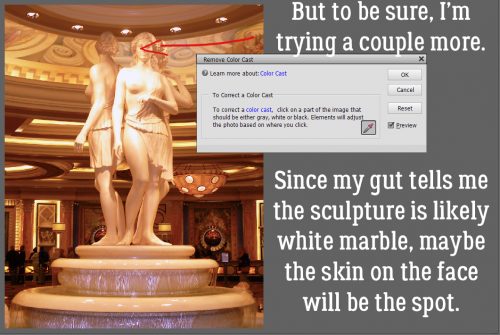
To be sure I’d gotten it right, I tried a couple more spots. I assumed the sculpture was marble, or intended to looklike marble, so I clicked on an area of cheekbone. There’s still a hint of sepia in the image though.

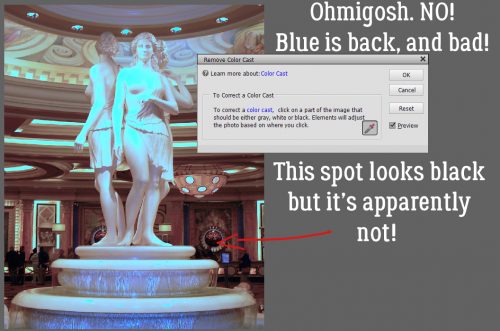
So I tried black again, clicking on the dark area of the mirror, shown below. Fooled again! It’s NOT black.

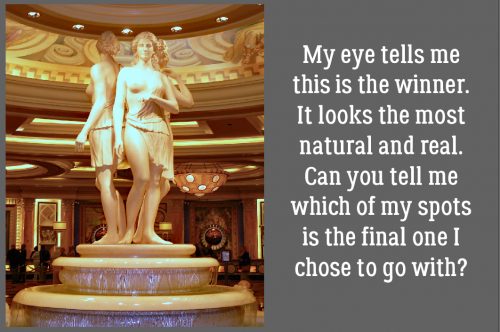
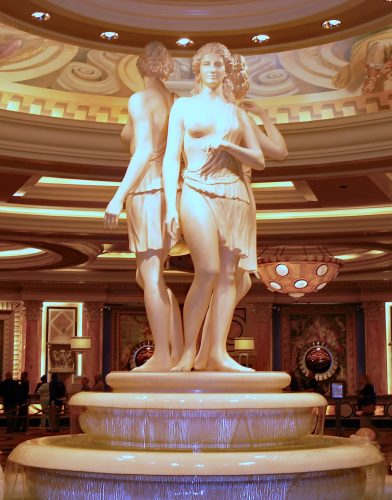
This is the one that my eye tells me is truest. With a little haze removal, it should be vastly improved from the original. Another photo saved!

Finished version… 5 minutes. Tops!


Tutorial Tuesday (Photoshop Elements)

What the Heck is a Vignette?

It’s been awhile since we did anything really creative using a Guided Edit. Today we’re changing that!

The dictionary has a number of definitions for the word “vignette”.

noun

  • decorative design or small illustration used on the title page of a book or at the beginning or end of a chapter.
  • an engraving, drawing, photograph, or the like that is shaded off gradually at the edges so as to leave no definite line at the border.
  • decorative design representing branches, leaves, grapes, or the like, as in a manuscript.
  • any small, pleasing picture or view.
  • small, graceful literary sketch.

verb (used with object), vi·gnet·ted, vi·gnet·ting.

  • Photography to finish (a picture, photograph, etc.) in the manner of a vignette.

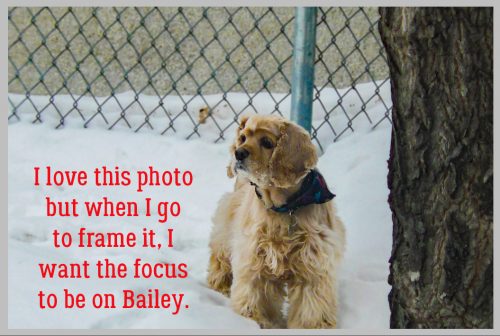
This photo – “a small, pleasing picture or view” – of my cocker spaniel Bailey (who left us 4 years ago) is my most favourite one of her. When I was sorting through a box of stuff I found a frame I had bought for this photo shortly before she died; I decided it was time to print and frame the photo, but wanted to increase the impact of it a bit first.

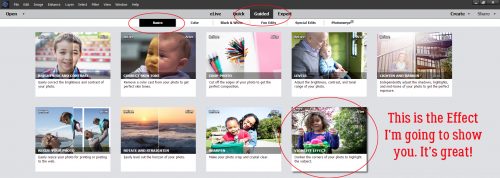
My first thought was to add a vignette effect to my vignette. Photoshop Elements has one in the Guided Edits menu, so here goes!

This particular effect has quite a few uses, especially when it comes to landscape photos where there’s an element or view that screams for sharper focus (attention-wise). But it would also be stunning with newborn photos, wedding photos and any number of others.

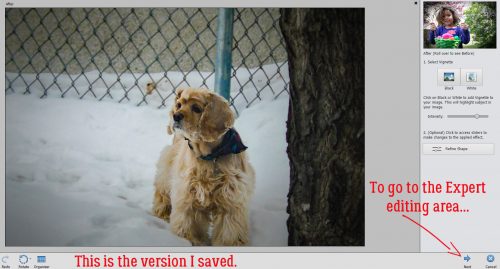
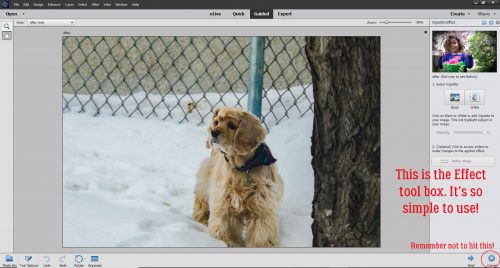
When you open the tool, this is what the interface looks like. Remember, down at the bottom right corner there are two buttons, a Next and a Cancel. The Next button gives you the option of saving, sharing or moving on to the Expert workspace. The Cancel button resets the image. So if you’ve made several adjustments and are pleased with your efforts, take great care not to Cancel it!

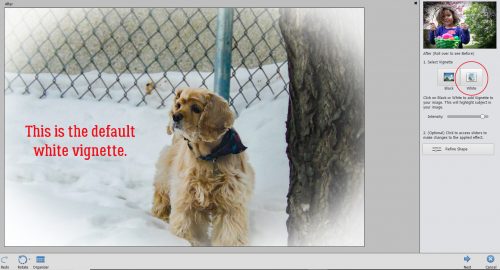
Obviously there are two vignette options here, Black and White. I’m showing you the white first, with the software’s default setting. It’s not the look I’m after, but I have some adjustment capability so let’s see what happens when I use them.

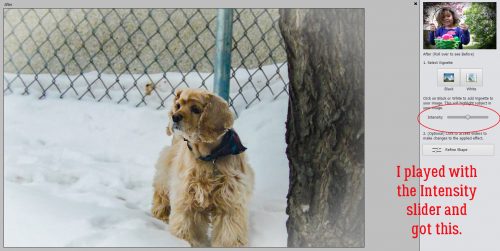
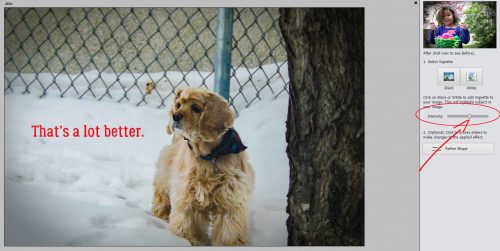
By decreasing the Intensity of the vignette effect, I get an effect I like better.

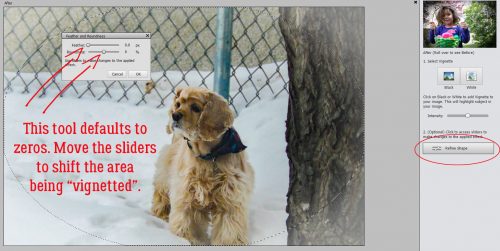
The button bar I’ve circled is the second adjustment tool, which lets the user shift the shape of the vignette and softness of the edges. I’ve shown you the defaults. The marching ants show you where the software has made its selection.

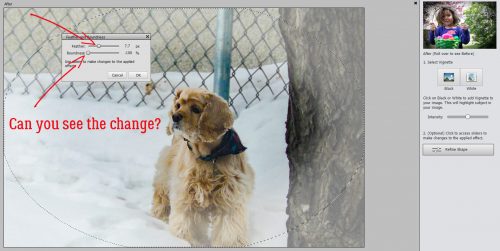
I moved the Feather slider over a bit to the right (to 7.7 pixels) and made the edge softer, then slid the the Roundness handle all the way to the left (-100%). The Roundness tool contracts or expands the selection edge. Can you see what that did to my photo?

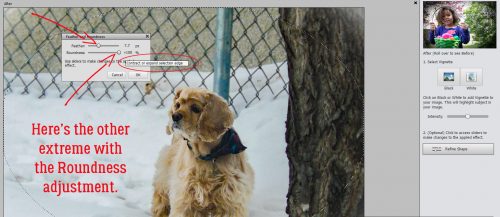
This is what I get when I move the Roundness slider all the way to the right without adjusting the Feather. But even with lots of tweaking, it’s not the look I’m after. So I hit the Cancel button.

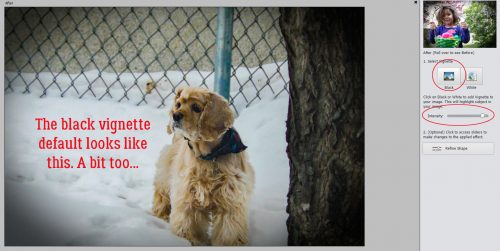
Then I tried the Black vignette. Here’s the image with the defaults. TOO too…

So I pulled the Intensity of the vignette down to about 55% and like it a lot better.

This time I pushed the Feather slider all the way to the right, 50.0 pixels.

Then I played with the Roundness, moving the slider left to -10%.

There it is! Bailey is the focus, the edges are darker and softer and I’m really happy with the way it looks. I can print it now and get it in the frame. If I wanted to work with this photo more, inside a layout for example, I would go to the Next button and make my choice of subsequent actions. I Saved it to my folder for printing.

Can you think of a photo in your collection that would be even better using this technique? (There’s another way to do this technique that’s a bit more work, and I’ll show you how in another lesson.)

What are Blend Modes?

Many of you have expressed the desire to learn more about Blend Modes, so today let’s take a look at this powerful Photoshop tool.

Blend Modes are available both in Photoshop and Photoshop Elements to assist you with your creativity. But what are they and why should you care?

Blend Modes change the way that layers interact with each other, allowing you to create a variety of looks with the same supplies, depending upon the Blend Mode you choose.

Screenshots in this tutorial are from Photoshop CC2019; however, you will find that Blend Modes work exactly the same in Photoshop Elements.

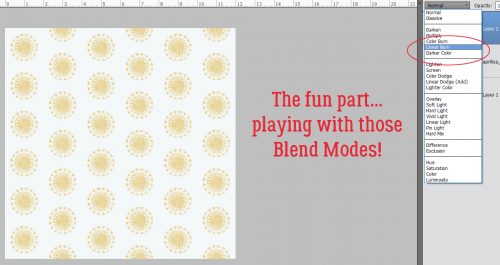
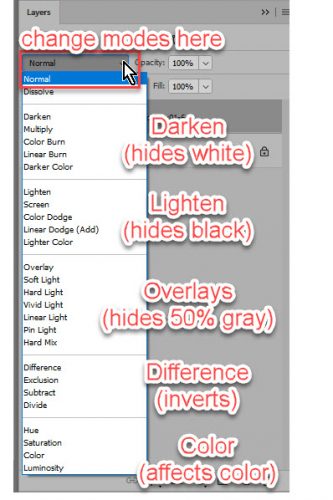
You will find the Blend Mode option at the top of your Layers Panel. The default is set to “Normal.” Click on the down-pointing arrow to the right and a drop-down menu will open with all of the options you see in the image below.

snickerdoodle-blend-modes-tutorial-1

Because the result of a Blend mode will depend upon the colors you are working with, there is not one formula that is perfect for every situation. However, if you have a general understanding of how Blend Modes work, you will be able to have a good idea which Blend Mode to start with when experimenting, depending upon what result you want to achieve.

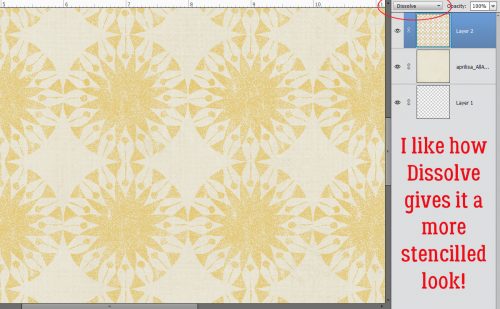
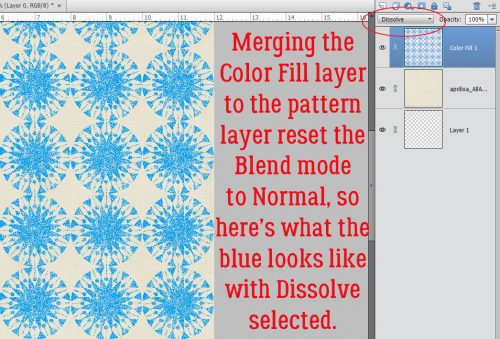
There are 5 main Categories, each their own use and options.  First listed is Normal. “Normal” is an unaffected image, and “Dissolve” can give your image a “frayed” look. I don’t know if I’ve ever used that category myself.

What I consider the “real” first Category is the are the options which will darken your images. Within that category, your options are: Darken, Multiple, Color Burn, Linear Burn, and Darker Color.

Moving onto Category #2, which lightens images, you also have 5 options, as shown in the image below. Categories 3, 4, and 5 also have their own options.

The best way to see how Blend modes work is to fill a layer with color, place an overlay on a layer above it, and just experiment. Try each Blend Mode to see what it does and how it affects your image. This will give you a good feel for the results of each option and you will be on your way to understanding what you can expect with each option.

Here is an example using a pink colored cardstock, with a grayscale Vintage Book Texture.  Overlay and Soft Light are my favorites here, and those are always good options to start with when you are using a grayscale texture.

snickerdoodle-blend-modes-tutorial-2Time Saving Tip:

Did you know that you can cycle through Blending Modes without using your mouse?  Here’s how:

  • Select the layer that you want to blend. In this example, I want to Vintage Book Overlay with a piece of colored Cardstock.
  • Click on the down-pointing arrow in the Blend Mode box to make it active.
  • Click on any Blend Mode to make it active.
  • Use the Up and Down or Right and Left arrows on your keyboard to cycle through the different Blend Modes

I hope you have found this helpful! If you would like to download a PDF of this tutorial, you may do so here.

Tutorial Tuesday (Fonts)

Fontastic Spring!

Once again I’m apologizing for not having a great tutorial prepared for you. I’ve been caught up in family obligations the last several days and haven’t had time for much else. I didn’t even get my family bible layout done. But I’ve noticed that almost all the comments on last week’s post mentioned the fonts I showed you. And I also noticed that I haven’t done a post about spring-y fonts. So there we’re going!

As I’ve mentioned before, I love dafont.com as a great source of free fonts; their selection is outstanding! I made a quick cruise through there and have found you a baker’s dozen of fonts (and a dingbat set) that would make great titles or subtitles for spring layouts. See if you agree. Each font is hyperlinked to the site; just click on the font name in the description.

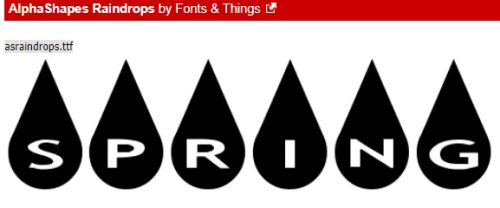
Alpha Shapes Raindrops might be what you’re looking for when you scrap rainy-day layouts. If you simplify each letter on its own layer, you can use the Smudge tool to animate your drops.

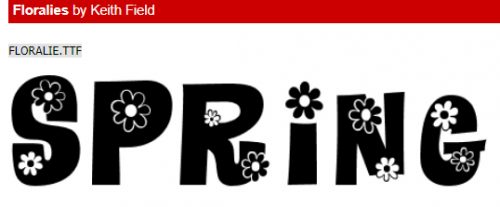
Floralies is similar to Blomster, but a little “lighter”.

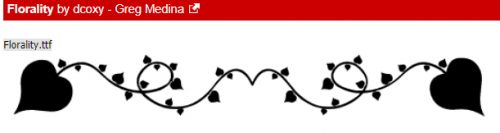
Florality isn’t technically a font, but the viny, leafy look of it is so pretty!

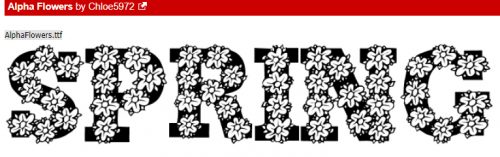
I’m thinking there are so many ways to make Alpha Flowers just POP off the page.

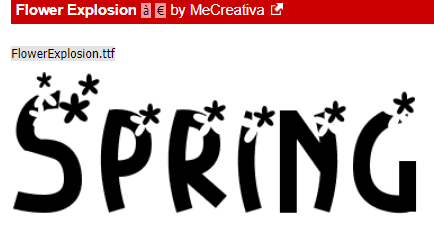
Flower Explosion is a little lighter too, but still really pretty.

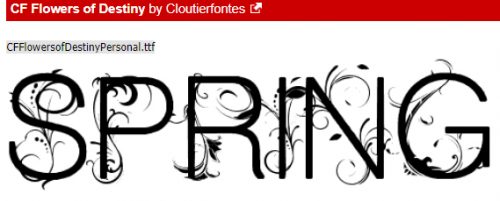
Think how beautiful CF Flowers of Destiny would look with a Blend Mode like Multiply! Ooh, and a gradient… smashing!

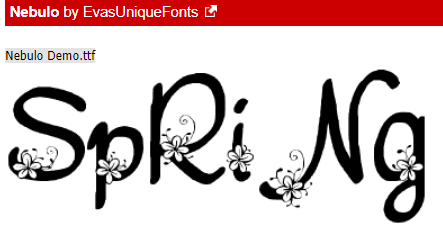
Nebulo is really gorgeous, just be aware that it’s a mishmash of capital and lowercase letters.

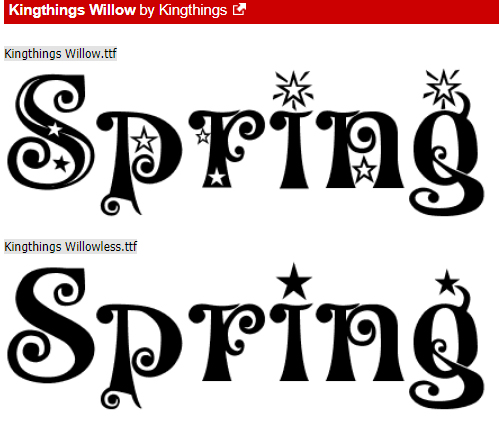
I just love this one! Kingthings Willow has two choices for even more freedom and control.

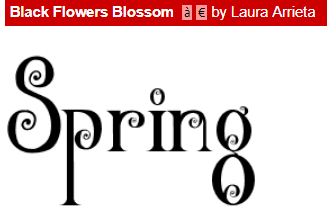
Black Flowers Blossom is just pretty.

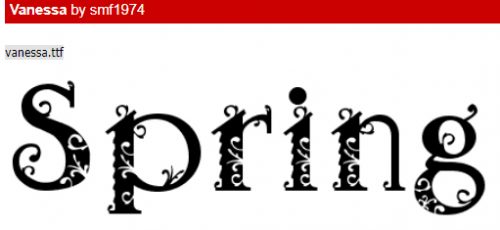
Vanessa is another really pretty font; imagine it clipped to a paper, maybe with a little border around it.

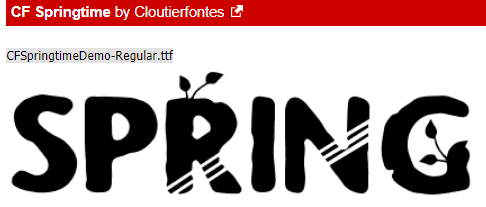
CF Springtime has a nice bit of heft to it, and those sprigs are a cute touch.

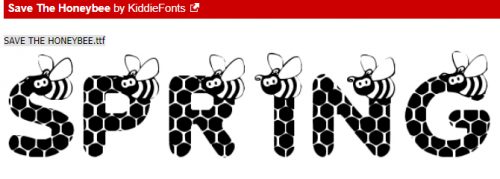
This whimsical little beauty would be an amazing addition of layouts with Day Dreams ‘n Designs‘ Daily Download kit Bee Mine. I think we also need to heed the message… Save the Honeybee.

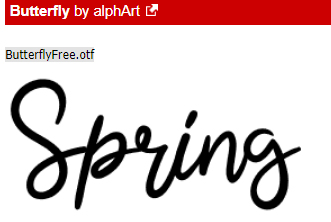
This one doesn’t say spring so much as the name of it does. I like it though. Butterfly

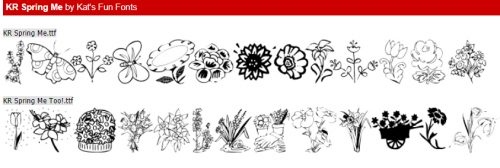
That leaves only the dingbat set. KR Spring Me has LOTS of spring-y images and so many possibilities.

Do you have any favourite fonts that make you think of spring? It looks like spring might actually be on its way to my corner of the world. Our temperature finally got above freezing on Sunday for the first time since January 31. That’s a long time to be cold!

Tutorial Tuesday (Potpourri)

Heritage and History: Recorded

Late last week, I connected with one of my distant cousins on my mom’s mother’s side through Ancestry DNA. I never expect anything to come from my contacting them, and am always so thrilled when they respond. This particular long-distance connection led to an explosion of “new” family members for me and the beginnings of several friendships. But perhaps the best thing that has come from this is that I now have several photos of the old family Bible, that dates back to 1884.

I know there are more than a few of you loyal readers who are also interested in your family history and in recording what you learn for future generations. My family Bible photos are going to make an amazing layout. And GingerScraps has pretty much everything I’m going to need to make it special. And I’m going to let you in on my design process.

First, did you know you can search the store using keywords? On the far left of the store’s home page, there’s a search box right underneath the log-in panel. I typed in “heritage” and the search returned THIRTY-TWO pages (more than 500!) of possibilities. I know the right kit for me to use for my special layout will be in there somewhere. Here are some of the options I’m considering.

Many of these kits are part of a larger bundle, which of course is your very best value.

My heritage layouts go in one of two directions; I either focus on a single photo or I go with a collection of them. Because the photos by themselves are just “nice” but don’t tell the story, lots of room for journalling is a must. Our GS designers have so many options for templates that it’s like an embarrassment of riches. Here are some options for multi-photo layouts.

For titles and journalling, there are nearly as many options for (free) fonts as there are days in a year. I like to use decorative fonts for titles, typerwriter fonts for journalling – it needs to be completely legible for the story to be preserved. Here are some that I like.

Now, my challenge to you is to see if you can guess which kit, template set and fonts I will use for my layout. Check in the gallery at the end of the week to see if you’re right!

4 Ways to Add Color Pop

Colorizers, by Snickerdoodle Designs, are a new product here at Ginger Scraps. But what are they and what do you do with them?

Colorizers by Snickerdoodle Designs

Colorizers by Snickerdoodle Designs

Hi! I’m Karen, of Snickerdoodle Designs; and I’m here today to show you how to use my Colorizers to easily add color to your digital scrapbook papers, text, elements, and shapes.

I’ve prepared a 2-minute video to show you how easy Colorizers are to work with. Take a look at the video, and then scroll down for 4 additional ways to add color to your digital scrapbooking projects.

4 ways to add color pop to your digital scrapbook pages Snickerdoodle Designs

1. Changing the Color of an Element

Many designers include graffiti, doodles, or other graphic elements in their digital scrapbooking kits.   They are usually provided in papers or colors that coordinate with the designers kit, which makes them super easy to use. But if you love a specific graphic and want to use it with a kit of a different color palette, using a Colorizer is a fast and easy way to achieve that goal.

Here is a piece of graffiti from This is Me November Graffiti. While it coordinates beautifully with the kit, it is also a piece that could easily be used on any scrapbook page with a simple recolor.

snickerdoodle-4-ways-to-use-colorizers-tutorial-1

We could add a Hue/Saturation Adjustment Layer, to change the color, from brown to blue in this example.

snickerdoodle-4-ways-to-use-colorizers-tutorial-2

But if we wanted to add multiple colors to the design element, using a Colorizer is a quick method. Place a Colorizer above the graffiti and clip the Colorizer to the mask, and you’re done! The variegated color adds a unique flavor to this piece.

snickerdoodle-4-ways-to-use-colorizers-tutorial-3

2. Coloring Black Stamps

Stamps can add great interest to our pages. Most often they are black or gray in color. We can blend them into our backgrounds, colorize them, and apply Styles to them. Another quick way to color black elements in with Colorizers.

This is an element from You Color my World.” In the kit, it is colored, but I have made it Grayscale for this tutorial. I am going to use Colorizer #8 from Pack 1 to quickly color this Stamp.

I clipped the Colorizer to the stamp and experimented with Blend Modes. We can get a variety of different effects, based on the color of the stamp and the color of the Colorizer that we are using. In this example, Hard Light gives the best result. Sometimes just clipping a Colorizing to an image adds enough color, so you don’t need to do anything else. How easy is that?

snickerdoodle-4-ways-to-use-colorizers-tutorial-16

If you really want to play and experiment try adding a Levels or Curves Adjustment, or a Brightness / Contrast Adjustment. Or use 2 Colorizers – one Colorizer for half the stamp and a second Colorizer for the other half of the stamp.

3. Coloring Grayscale Backgrounds, Basic

No matter what type of grayscale background you have handy, whether it is plain or patterned, using a Colorizer is a quick way to create a lovely background paper.  Place a Colorizer on the layer above your grayscale background and experiment with Blend Modes of the Colorizer. (Grayscale paper from Crumpled Textures 01).

4. Coloring Grayscale Backgrounds, Advanced

If you want a little more fun with the Colorizers, start with an artsy, mixed media background. The texture I am using for this example is from my Artsy Textures 01, #6. I placed the Colorizer on a layer above the grayscale texture and changed the Blend Mode of the Colorizer to Screen.

Next, I merged the grayscale texture and the Colorizer to create one layer.  I placed the merged layer above a Crumpled Texture and changed the Blend Mode of the merged paper to Difference.

It was way too dark for my taste, so I added a Levels Adjustment, followed that with a slight Curves Adjustment. I was happy with that result.

Colorizers were designed to give you a multitude of options. You can get fabulous results by just using one Blend Mode, or you can use multiple techniques to get the effect you want. The key to using Colorizers is to play, experiment, and just have fun!

Go ahead! Give it a try!  Here’s a sample for you to experiment with. Just click on the image to download.

If you would like to download a PDF of this tutorial, you may do so here:  4 Ways to Add Color Pop.

Tutorial Tuesday (Photoshop Elements)

Magic Eraser!! (Not Mr Clean but close)

I know I can’t be the only one who collects brochures from the attractions I visit when I travel. And I’m pretty sure I’m not the only one who likes to make my own journal cards to go with my photos when I scrap those travel photos. I really wanted to use the Wells House logo somewhere on my layout below and decided this would be a good time to try something new (to me). The template I chose, from the GingerBread Ladies mega-collab Oh Snap! had a journal card spot, and it inspired me. And ADB Designs‘ January Daily Download kit Cozy New Year was the perfect kit to go with my photos.

The logo is pretty well delineated in the image below, and I just want the logo itself. I could put it on a new document and extract it using one of the methods I’ve shown you in the past, but I wanted to try something new. So let’s get to it!

I’d never tried the other options in the Eraser Tool menu and this seemed like a good time to give it a look. That one with the yellow starburst is called the Magic Eraser Tool and it is indeed magical!

There are some settings that are vital to use with this technique. The Opacity has to be 100%, and all three boxes along the right side of the menu should be checked: Sample All Layers, Contiguous and Anti-Aliasing.

The screenshot says it all… I really did just click on the background and it vanished. (See the new transparent background?)

So then I wanted to play! I have a bunch of Bitmoji images saved to my computer and this one, which is pretty much how I’ve looked the whole month of February, was my next victim.

CLICK!

It was so easy, I wondered what would happen if I tried it on a photo. This one looks like a good choice to experiment with.

Oh. Didn’t expect that!

The tool magically erased some of his t-shirt along with the sky. That’s a limitation – the shadow isn’t enough of a contrast to the sky and Elements couldn’t tell

So I combed through my stock photos for one with more obvious contrast.

Now I’m starting to understand how the tool works. I’m going to need to click on every. single. different. colour. variation. Too much work!

So how about this one? Will it work better?

Not so much.

Maybe this one will work.

Or maybe not. Now I had to see what else I could do that would be smart, not hard, to preserve the stuff I wanted and remove the stuff I didn’t.

I went to the Magic Wand tool to see if it would be quick and easy enough to extract the woman and only the woman.

The marching ants surrounded her hair well enough. So I clicked on Select>Inverse (I lie. You know I went with CTRL/CMD>Shift>I.) to invert the selection… to “select” the background and not her hair.

Now you can see the marching ants around the outside of the photo. Back to the Magic Eraser I went.

Much better! The wisps might be a problem.

I clicked on other areas of the background that were still there.

Not bad! The only fiddly part of this is the wispy hair now.
I wanted to try it one more time, with this crest from one of the radar stations I lived on when I was a kid. It’s a fair representation of the place, I’ll say that! And it has a more detailed edge with that wreath of maple leaves.

One click got rid of most of the background, but left the white in the spaces between the leaves. You can see them along the right side of the screenshot. I’d already clicked a few more times in the spaces to the left side. It only took about a minute to go all the way raound and get rid of the rest of the white background.

Sweet!! I’m not sure what I’ll use this for, and I’m going to see what I can do about wispy hair for a future lesson, but I can feel you chomping at the bit to try this one yourself.

Have fun!!

Tutorial Tuesday (PSE-Word Mashup)

A Whole New Meaning to Copy-and-Paste!

Welcome to the tutorial that almost wasn’t! The last week has been a little difficult around our house and the weekend was particularly so. I didn’t have time to put together something to share with you before I had to go back to work yesterday. 12 hour shifts don’t leave a lot of energy, mentally or physically, and I always do two in a row so I was expecting to have to disappoint you all by posting a “sorry…” and a promise to do better. But the over-staffing fairy visited me this morning and I magically got the day off. Not having a topic in mind, I had to do some pondering. And then I learned something myself that I knew would be perfect for this week. So we’ll settle for late, rather than not at all. Here goes!

Have you ever put your heart and soul into a layout, then spent forever coming up with the perfect journaling – only to hate the way the journaling looks, or worse… see a glaring typo? Have you ever wished PSE came with a spell-check? Or that you could copy-and-paste something from a website? Well, have I got the trick for you! Word and PSE work together! And even better… all your fonts are there in Word too!

Your Word version may be different from mine; the interface might look different but this is pretty basic, and all the things I’m going to show you will work with any version. I opened a new blank document in Word, chose a font and set my formatting so that my text would fit inside a border on a beautiful journaling blank I pulled from Ooh La La ScrapsShabby Chic collection.

I love using quotations for a variety of reasons. Like not having to think too hard! I typed out this one in a matter of a few seconds. I changed the size of the font for Mr Bergen’s name.

I just spotted a typo on my screenshot below. RATS! Word’s spell-check wouldn’t have caught it either, but it DOES catch those transposed letters, “e”s that should be “a”s and that kind of thing. It also capitalizes the first word of each sentence for you if you forget.

Then I opened up Elements on my desktop, dropped my journal blank onto a new document and set up the Text tool with the same font settings that I chose in Word. If I skipped this step now, Elements would default to the last settings I used.

Back to Word… I selected the text then right-clicked to open up a dialogue box. It looks like this. I want to Copy the text. (WSNH tip: the same keyboard shortcuts I’ve shown you in previous tuts also work exactly the same in Word, so CTRL/CMD>C will work to copy the text.)

I flipped back to Elements and Pasted my text into the journaling space. That can be done by right-clicking then choosing Paste from the dialogue box, or CTRL/CMD>V. Did you notice that Elements ignored the different text sizes?

Now I have the ability to change it up to suit my layout. I changed the text colour first by pulling the gray from the border.

Then I changed the font size on Mr Bergen’s name again. Now that I know the font size changes made in Word don’t move over to Elements, I can skip that step in the future.

Even better, it’s totally possible to Copy whole sections of text from a web site or other document on your computer and Paste it into Word. As you can see in the screenshot below, I’ve selected a new quote from my favourite quotations site.

Then I Pasted it into Word with a couple of clicks! Yeah. I wasted time resizing Ellen’s name. (Did you catch the typo in this screenshot too?)

Here you can see that I’ve got Elements open and it’s just waiting for me to Copy-Paste Ellen’s words of wisdom over.

Oh, right… I didn’t go to Elements and set up the font. So this is the font, size and colour I used for the last layout I created.

So I just Undid that step and started over. But this time I decided to use a Text Box. This handy tool helps to constrain the text so it doesn’t bleed out into areas where I don’t want it. To create a Text Box, with the Type tool click-and-drag from one corner diagonally to the opposite corner of the area you want to cover with text. This journal blank made it easy by having reference points in the border.

And then I pasted Ellen’s quote into my text box. Notice that it’s now centre-justified, rather than left-justified as it was in Word. I had “Center” selected in the Text tool settings and Elements over-rode Word.

This time I didn’t have too many changes I needed to make, other than shrinking Ellen.

But to show you how easy it is to change it to suit your purposes, I switched the angle from upright to right-italic and changed the text colour. I want to try this trick with texting on a path, but wanted to get you the basics now. Stay tuned!

Tutorial Tuesday (Photoshop Elements)

It’s All About the EXPOSURE!

Today’s tutorial comes to you courtesy of my weekend wandering through that black hole known as Pinterest. I wasn’t even looking for inspiration but BAM! there it was!!

I don’t know about you but I have a whole folder of photos that are unscrappable for one reason or another. Many of them are seriously under-exposed… and they’re usually of something I really, really, REALLY wanted to use for a layout. Like this one, for example. I took it on my first trip to Ireland in 2014; there’s a lovely 2-storey manor house in the centre, surrounded by idyllic countryside. But you’d never know it. All my efforts in the past to improve these shots were failures, mainly because they looked really over-processed and artificial. Then I found this method of fixing these oh-so-dark shots. To wow you thoroughly, I’m going to start with this one, as my worst example of underexposure.

The first thing to do is make a copy of the image, either by right-clicking on the layer and selecting Duplicate Layer, or simply using the shortcut CTRL/CMD>J. If you choose the first method, there’s an extra step, because PSE is going to ask you to name the new layer. The shortcut just makes a copy, and calls it that. (You already know what method I use.)

Now for the magic! Just change the Blend Mode from Normal to Screen. Click on the button at the immediate upper left of the Layers panel and select Screen from the drop-down menu. For those of you who don’t know much about Blend Modes, they’re really great tools; I put together a tutorial on what they that you can find here.

Can you see the change that simple step has made? Hedges!!Shrubs!

Just by copying the Screen layer, I can bring out more details.

Still not great, but so much better…

So I added another copy of the Screen Layer.

And another…

I kept adding copies of the Screen layer and the image just kept getting better and better.

It’s getting there, but still has some room for improvement.

Almost there!

And then… YES! I can see the leaves on the shrubs in the foreground, the trees on the hill and have a much better photo.

Then I Merged all the layers together. Select all the layers then right-click somewhere within the Layers panel, choosing Merge Layers from the drop-down menu. Or do what I do,  select the layers then CTRL/CMD>E.

I’m happy with the exposure now, but I feel like the image is a bit hazy. So my next favourite new tool is the Enhance>Haze Removal (or CTRL/CMD>ALT>Z).

It doesn’t change the image in a huge way, but the leaves are sharper, the house looks sharper and the colours are a smidge more saturated.

Let’s try it again, this time with an indoor photo taken without a flash. No harsh shadows, but also no background detail…

The first Screen layer does this.

Adding a second Screen layer brings out more of the carved panelling.

Now I’ve got three Screen layers and I’m almost happy.

Four Screen layers and I’m happy.

Merge those layers and carry on! This one isn’t too hazy so I didn’t use the Haze Removal tool.

Let’s try it one more time, with an image that isn’t terrible, but could use a little help.

First Screen layer…

I added another one, then one more and now could see the beams under the roof a lot better.

Then I Merged the layers.

I wondered if Haze Removal would make it even better. And to my eyes it did.

So that’s a handy trick for the under-exposed shots. What about the ones that are just a little blown out – over-exposed? Is there a quick trick for them? YES! This photo is from my daughter’s wedding trip to Jamaica.

Now, this wasn’t in the little piece I found online, but I thought about if for a minute and decided to try something… it worked! I copied that first layer but instead of using the Screen Blend Mode, I chose Multiply.

Look at that! It’s a bit dark, but much better with just ONE blended layer on top of it.

The easiest way to adjust it was to lower the Opacity of that Multiply layer to 92%.

Merge those babies!

I gave it the Haze Removal treatment too.

And there it is!

This next one, a gallery I shot in New Orleans, doesn’t need a lot of adjusting either, but I wanted to know if I could love it more.

After the first Multiply layer I feel it’s a bit too shadowy now. But I know how to fix that.

Ooh, that’s better! 82% is about the right amount of Opacity here.

I love that this trick is so much less labour-intensive! I Merged the two layers…

and hit it with the Haze Removal tool too.

I saved the worst for last. This wall paper is in the circular entry hall of the manor at Coollattin, the estate where my Irish ancestors lived and worked until 1847. It’s hand-painted watercolour on heavy paper, and it’s absolutely beautiful. But you wouldn’t know it from this photo!

One Multiply layer later… I think it’s too dark now, but when I was batch-editing I thought it was fine.

I kept going with the process and reduced the Opacity to 80%.

It’s better than the original so I Merged the two layers.

And got rid of the Haze.

There’s a lot of detail visible now, and the colours are much more saturated.

Then, just to see, I added a Screen layer and it’s PERFECT!

Are you already looking through your photo folders for shots to experiment with? I bet you are!

Tutorial Tuesday (Photoshop Elements)

Another Font-to-Alpha Option

The idea for this technique came to me while I was using Nyquil to fight off a cold and was probably not really coherent. But it seemed like a stroke of brilliance at the time so I decided to try it. It didn’t work the way I saw it in my mind’s eye, but I like how it came out in the end.

When turning a font into an alpha, bevels are very handy style tools but they don’t always give the look I want, being more sharply, blockily cut. I wanted to create a more curvy but smooth alpha with a paper clipped to it. So when it occurred to me that I could try using a rounded, beveled Style on my text then clipping the paper to that, I HAD to try it! Alas, it didn’t work the way I expected… I still ended up with a flat, 2-dimensional image. So I went back to the drawing board.

This font, called Lovelings (by a designer named Darrell Flood) was found at 1001 Free Fonts. It’s got that solid, curved look that makes great alphas.

I’ve started to automatically make a copy of my original text layer before I make and adjustments to it, just in case I need an untouched one later.

Then I started trying my idea out. And failing. Miserably. More than once! But then I tried this and it worked, so you get to see it. On my TOP layer, I added a Layer Style from Miss Mis DesignsHustle and Heart.

I used the cherry-red acrylic style and didn’t make any adjustments to it at all. It looks pretty great, but it isn’t the effect I was after.

So I turned the visibility for that layer off and went to the BOTTOM, original layer.

Then I dropped a patterned paper from I Believe in Love on top of the text. PSE in its later incarnations has an unfriendly habit of scaling objects to a single dimension (height) of the canvas, so it’s a pretty minuscule little swatch here.

To overcome that I resized the paper to 400%. It’s easy to do precisely by clicking on one of the corner handles of the Bounding Box, which opens up the Transform menu, then simply typing in the dimensions I want.

Once I had the paper big enough to work with, I Clipped the paper to the layer below it. CTRL/CMD>ALT>G is the WSNH shortcut, or Layer>Create Clipping Mask works too.

As you can see, the acrylic layer (visible again) is a little bit transparent and lets the paper show through. But not enough.

Easy enough to lighten the top layer some to let the paper show, but without losing the curvy, round effect of the acrylic altogether. I only decreased the layer’s Opacity to 80%.

All that was left was to select and Merge all the layers (CTRL/CMD>E or right-click>Merge) and I was ready to create the rest of my siggie.

I’m going to keep trying to get a rounded bevel on a font that stays put when I clip a paper to it, and if I succeed, I’ll show you how I did it.